
The Website of
TRENTON CREATIVE ENTERPRISES
(TIMOTHY CRAIG ELLIS DBA TRENTON CREATIVE ENTERPRISES)

CELEBRATING 16 YEARS ON THE INTERNET
2008-2024
INTRODUCTION
Gastonia, North Carolina was established at the intersection of two railroads in 1877. The textile industry was planted in the city in 1887 and found fertile ground for its flourishing with the rapid growth of many mills and their accompanying employee villages. In 1976, with the opening of Eastridge Mall,Uptown ceased to be Gastonia's retail center. The area then endured two major governmental redevelopment projects: a devastating Main Avenue "beautification" that reduced onstreet parking and drove several struggling businesses out of existence and the lowering of Southern Railway's main line tracks into a ditch that wiped out one-third of Uptown's built environment. The twenty-first century witnessed the demise of textiles as a major industry in the United States. The center city, which by that time had become known as "Downtown" (possibly because of the direction it had taken), continued a long, slow decline as development increased at a fever pitch on the eastern fringe of the city (the Charlotte side). In recent years, there had been growing hope that private development would bring life back to the lightly-traveled streets, and some progress had indeed been made. But then the tentacles of government returned to the arena, bringing attention and controversy back to the heart of Gastonia. Political arrogance once again wreaked havoc, and irreplaceable buildings fell. In their place was raised a monument to narcissism, about which future citizens will wonder. Redemption is possibly at hand with the success of the Loray Mill Project and completion of the Franklin Urban Sports and Entertainment Project ("FUSE"} on former Trenton Mill Village property and the Trenton Mill Lofts. This is where we find ourselves in 2024.
"What was here before FUSE?"
From farm to textile mill and village to mid-century commercial district to 21st century multi-use property, the fascinating story of the evolution of the Franklin Urban Sports and Entertainment district unfolds throughout the pages of this website.
To some an eyesore. To others a reminder of...
A shopping wonderland!
A tribute to the former home of Sears, Roebuck & Company
and its amazing architect,
Fred M. Simmons.
With the former Sears, Roebuck & Co. department store on West Franklin Boulevard now only a memory, it is fitting that we take a moment to remember the building and its architect in former days. Both represented a time of exuberant enthusiasm and unity in the Spindle City before politics and demographics forever changed Gastonia and created, in essence, two cities. The late Mr. Simmons (his groundbreaking modernist office still stands on East Dixon Boulevard, US Highway 74, in Shelby) was a pioneer aviator, engineer and architect, and, at the time of his death at age 99, was the oldest living Eagle Scout in the eleven-county Piedmont Council BSA. Learn more about him by reading an article published in the Shelby Star December 15, 2014 and his obituary, which appeared in the Gaston Gazette December 11, 2014. Never forget that every structure built by the hand of man was for a purpose. Sometimes that purpose was to construct something that was modern, convenient, attractive, and wondrous, as was the case of Gastonia's class "A" Sears Store. Pass the FUSE Project stadium and remember.
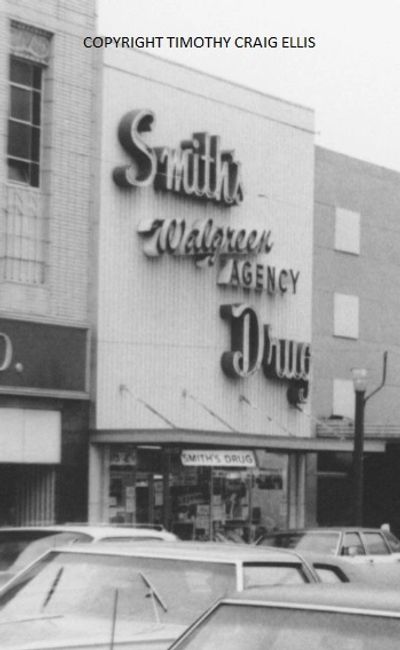
THE END OF AN ERA
On Wednesday March 23, 2016 Smith Drugs closed its doors. Its passing marked the end of Old Gastonia's retail history on West Main Avenue. This picture was taken from a series recorded just before the beginning of the removal sale of Matthews Belk department store on June 23, 1976 and appears in A Glimpse as It Passed: Scenes from A Vanished Gastonia, North Carolina, 1972-1992 published by Trenton Creative Enterprises © 2004.
OLD STOWE'S FLORIST NEON SIGN, GASTON AVENUE AT NORTH FIRESTONE STREET, MARCH 2009.
GASTON AVENUE ECHOES 2009
On a sunny March Sunday afternoon in 2009, after church and lunch with my mother (the primary inspiration for my love of Gastonia history), I rode over to Gaston Avenue to take some pictures of the old Gastonia Bottling Company building at Gaston and Firestone. To finish the roll of film, I turned to my right and snapped a quick shot of the old neon sign that once announced the location of Stowe's Florist to an almost unbelievably different "across the tracks," back when the Airline / Gaston Avenue area was full of life and vitality. I had the film developed and put the pictures in a box with hundreds of others. Life rolled on. Fifteen years passed. Mom is gone, the Firestone Street railroad crossing is gone, the Gastonia Bottling Company building is gone, and Stowe's Florist is gone . We often focus upon the big things of Old Gastonia: The Loray Mill, The Lawyers' and Commercial Buildings, and so on, while the small places that figure so prominently in our collective and individual pasts quietly disappear without mention or mourning. These are the real landmarks of Old Gastonia and of Old Anyplace. They are worthy of preserving in pictures, memories, and the oft-recounted stories of our lives. TCE
Above are the pictures captured Sunday afternoon March 8, 2009 of the former Gastonia Bottling Company building at the northwest corner of North Firestone Boulevard and Gaston Avenue.
WHAT WAS CAN BE AGAIN!
One of our primary goals at VintageGastonia.com is to refute the misconception regarding the older parts of the city that they were always dilapidated and dangerous. Native Gastonians who remember the years before 1970 are often shocked at the views newer residents have toward places that were, in our minds, only recently filled with life and vitality. The wastelands of old West Gastonia (now referred to as the western edge of Downtown) are slowly being stirred from their restless and troubling slumber by the energy and continuing promise of the advancing Loray / Firestone Mill and Franklin Urban Sports and Entertainment (FUSE) projects, spillover from Charlotte's burgeoning population, and the massive influx of newcomers from other parts of the USA.
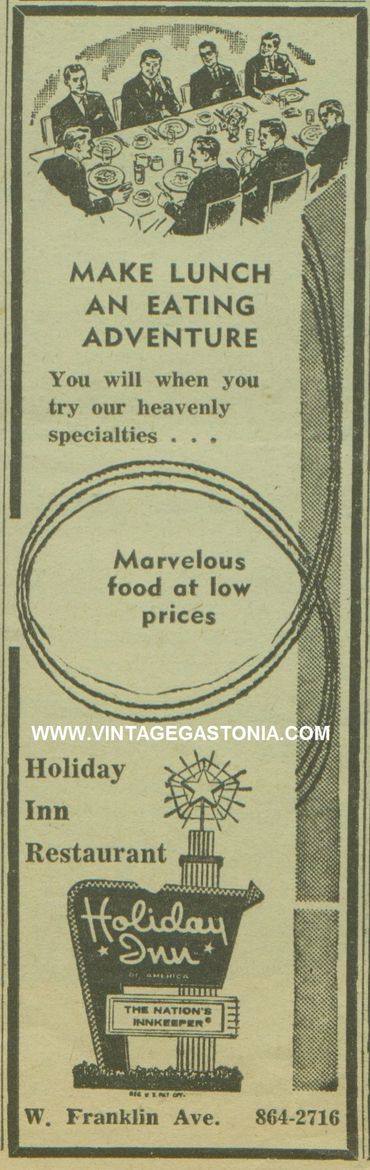
Gastonia's original Holiday Inn was constructed on former Trenton Mill Village property in 1962 amid much fanfare. For a time, it represented the highest development of the hospitality industry and was state-of-the-art for the company.
Within a short time after the motel's construction, the bulk of the remaining Trenton Village property was sold for the construction of a Sears Roebuck Company
class "A" store. Ample parking was provided in front of the store on Franklin Avenue with an additional two blocks of well-lighted space at the rear entrance across Main Avenue bounded by Trenton Street, Hill Street, and the Southern Railway tracks.
These anchor institutions and the surrounding churches, homes, stores, and the sparkling new YMCA teemed with life. It was a good place.
Sometimes the past presents a picture of what the future can be.
Our mission is to be interpretive and educational as well as visual and entertaining.
Thank you for visiting.
(Credits: The Holiday Inn Postcard was produced by Curt Teich & Co., Chicago, c.1960; the newspaper clipping is from the "Weekender" supplement to the Gastonia Gazette, October 31, 1965.)
HOW AND WHY THIS SITE BEGAN

This is the book that led to the creation of this website.
Now in its nineteenth year of publication.
Visit the "ABOUT" page to read how it happened.
THANK YOU FOR VISITING
VINTAGEGASTONIA.COM.
MORE THAN 218,547 VISITS
SINCE FEBRUARY 2008.
Copyright 2024 Trenton Creative Enterprises. All rights reserved.
Note: This is a commercial website. It is the creation of Timothy Craig Ellis, DBA Trenton Creative Enterprises, who holds registered copyright protection over his photographs and reserves copyright over design, layout, and content of this website. Intellectual property rights are reserved under the Digital Millennium Copyright Act (DMCA) and other pertinent laws and regulations.
We may seek legal remedies against any who reproduce or repost material contained in this website without first obtaining permission in writing. We monitor websites and social media pages regularly.
Please contact us for information regarding linking to www.vintagegastonia.com Help us keep the site open for everyone. Thank you for your cooperation.
Powered by GoDaddy